





Physical Education
Physical Education
Head of Department: FMcCabe@woolwichpolyboys.co.uk
A successful Poly PE student is someone who has a positive attitude and always tries their best in all activities they encounter at their particular ability level. He is able to demonstrate clear knowledge and understanding of key concepts across a wide range of sporting activities and shows commitment, leadership, creativity and perseverance in lessons and extracurricular activities. He understands how not just to explain, but lead, a healthy and active lifestyle, making positive contributions to physical, mental and social well-being. His knowledge extends to deeper tactical thinking and sharp decision-making and this is done confidently both as an individual performer but also by working as part of a team. As a department, we ask our students to smile, sweat, succeed in all they do and the perfect PE performer will do this.
key stage 3 pe curriculum map
This curriculum map exemplifies the Key Stage 3 Physical Education provision and reflects a broad, balanced and ambitious curriculum that is inclusive for all pupils. It has been carefully sequenced to develop pupils’ knowledge, skills and understanding over time, enabling all learners to make sustained progress regardless of starting point.
The curriculum is structured around a planned rotational model across Years 7 to 9, ensuring that pupils experience a wide range of activity areas, including invasion games, net/wall games, striking and fielding, athletics, fitness and alternative sports. While this document provides a snapshot of one academic year, all activities are mapped across the three-year programme to guarantee full curriculum coverage and equity of opportunity.
Through this approach, pupils:
- Build and revisit core knowledge and fundamental skills, allowing for increasing depth and complexity
- Develop transferable concepts, including tactical awareness, decision-making, and problem-solving
- Experience both traditional and alternative activities, promoting engagement and inclusivity
- Are supported to improve through ongoing assessment, feedback and reflection
The curriculum ensures that all pupils leave Key Stage 3 with the physical literacy, confidence and understanding required to lead healthy, active lifestyles and to engage successfully in Key Stage 4 Physical Education.
Year 7, 8 & 9 PE Curriculum Map
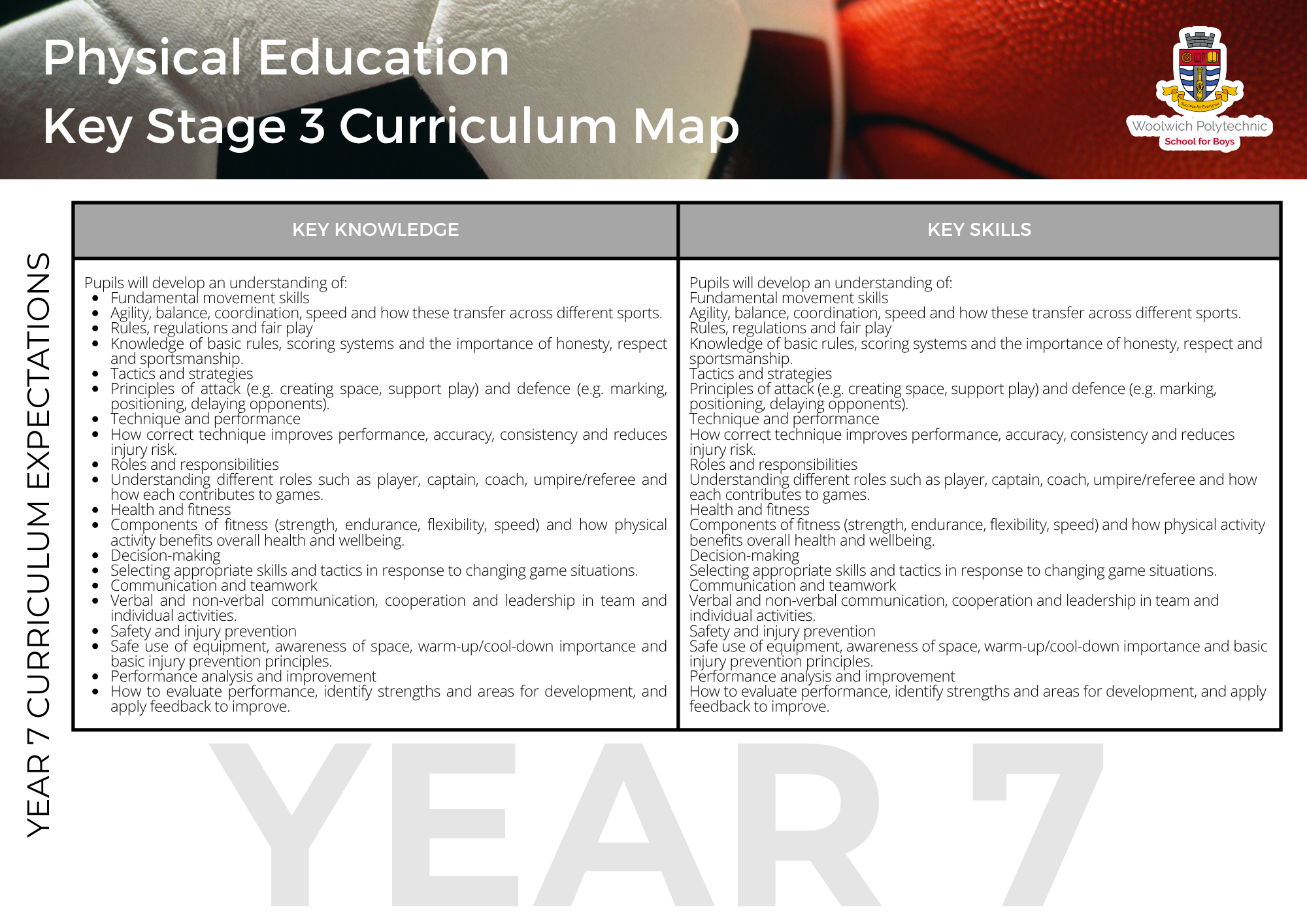
key stage 3
Key Stage 3 Curriculum
Our Key Stage 3 PE curriculum is designed to allow all pupils to naturally progress through a broad range of competitive and high-quality physical activities, whilst at the same time providing opportunities for success and personal development.
Pupils will have a chance to become confident and competent in the activities which they undertake, leading to one of our main departments' aims of stimulating pupil interest and enjoyment in PE, so that a fit and active healthy lifestyle may be achieved.
Students will study football, basketball, rugby, hockey, fitness, athletics, cricket, softball, tennis, table-tennis, badminton, handball, hockey, alternative sports and swimming throughout KS3.
The PE department here at the Poly encourages every student to attend at least one extra-curricular club, either before school, during lunch or after school per week. Check the department noticeboard for the latest opportunities.
key stage 4 pe curriculum map
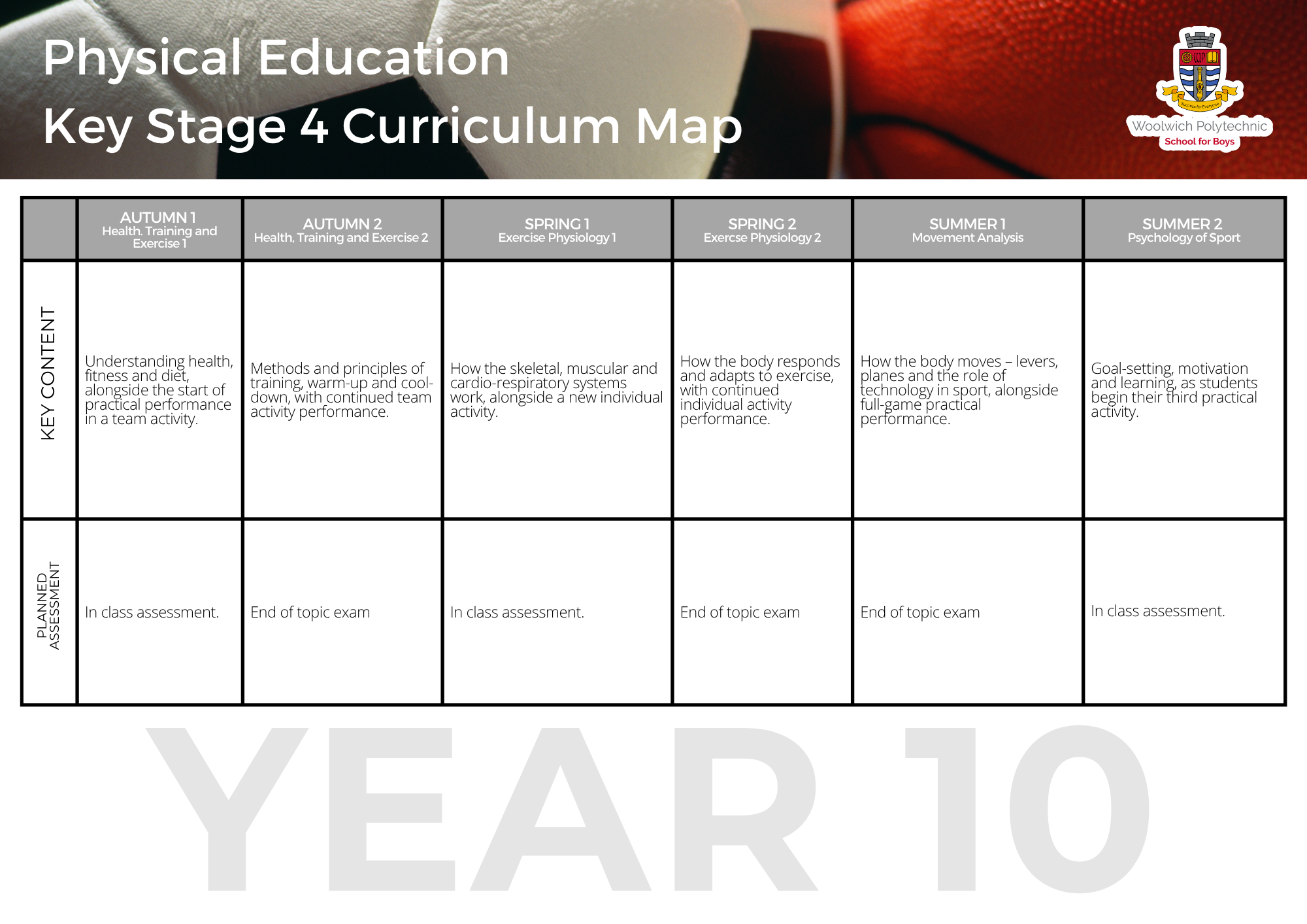
key stage 4
All Key Stage 4 students have core PE lessons. They may also choose Sport Studies as an additional option subject.
GCSE Physical Education (Eduqas) combines the practical skills students already love with a deeper, scientific understanding of how the body works, how performance is improved, and the social and cultural role sport plays in the wider world. It is a popular, hands-on option for students who want to keep sport at the centre of their timetable while developing valuable academic and analytical skills.
What is GCSE PE?
The Eduqas GCSE Physical Education specification is broad, coherent and practical, designed to inspire, motivate and challenge students while helping them make informed decisions about further study and career pathways. It makes real connections between theory and practice, so students apply their understanding of the factors underpinning physical activity and sport to actually improve their own performance.
GCSE PE is a two-year course studied across Year 10 and Year 11. It is split into two parts:
- Component 1: Introduction to Physical Education (60% of the final grade) – a 2-hour written examination (120 marks) covering five areas: Health, training and exercise; Exercise physiology; Movement analysis; Psychology of sport and physical activity; and Socio-cultural issues in physical activity and sport. Students answer a range of short and extended questions based on stimuli and sources.
- Component 2: The Active Participant in Physical Education (40% of the final grade) – non-exam assessment, marked by the class teacher and externally moderated by WJEC. Students are assessed as a performer in three practical activities (one individual and one team), plus a written Personal Training Programme linked to their chosen major activity.
This balance of theory and practice means students are assessed not only on their sporting ability, but on their understanding of fitness, anatomy, psychology and the wider context of sport – skills that are just as relevant to a future in sports science, coaching, medicine or physiotherapy as they are to sport itself.
What skills will I develop?
- Theoretical knowledge and understanding of the factors that underpin physical activity and sport, used to improve performance.
- An understanding of how physiological and psychological state affects performance in physical activity and sport.
- The ability to perform effectively in different physical activities by developing skills and techniques and selecting and using tactics, strategies and/or compositional ideas.
- The ability to analyse and evaluate performance in physical activity and sport in order to improve it.
- An understanding of the contribution physical activity and sport make to health, fitness and well-being.
- An understanding of key socio-cultural influences that can affect people’s involvement in physical activity and sport.
- How does the course work?
Theory and practical lessons run alongside each other throughout Year 10, so students are developing their practical activities at the same time as building the knowledge they need for the written exam. By the end of Year 10, students will have been introduced to all three of their practical activities and to four of the five theory topics.
In Year 11, students complete their final theory topic and carry out their Personal Training Programme, recommended to run for a minimum of 8 weeks and built around one of their assessed practical activities. The written evidence covers five stages: a self-analysis of current performance, a plan with a clear objective, completion and monitoring of the programme, an evaluation of the programme and its results, and recommendations for improving personal performance. Students are not assessed on whether improvement actually happens, only on the quality of this process.
Practical performance and coursework are completed and internally assessed by the end of the fourth term, ready for external moderation in March. The final term of Year 11 is then dedicated entirely to revising and preparing for the Component 1 written examination, sat in May or June.
What will students study?
Across the course, students explore:
- Health, training and exercise – fitness, diet, the components of fitness and methods of training.
- Exercise physiology – how the skeletal, muscular, cardio-respiratory and vascular systems respond and adapt to exercise.
- Movement analysis – how the body moves, including levers, planes of movement and the role of technology in sport.
- Psychology of sport and physical activity – motivation, goal-setting, guidance and learning skilled performance.
- Socio-cultural issues in physical activity and sport – participation, provision, the media and ethics in sport.
Alongside this, students are assessed as performers in three practical activities of their choice – one individual and one team activity, plus a third activity of their own choosing from the full list of WJEC Eduqas-approved sports and activities.
Where can GCSE PE lead?
GCSE PE builds on what students have already studied at Key Stage 3 and provides a strong foundation for studying Physical Education and Sport at Level 3. It is also supports future pathways into coaching, the fitness industry, physiotherapy, sports medicine, teaching and sports journalism, among many others.
gcse pe: inclusion & access
A summary of how the Physical Education department ensures GCSE PE remains an accessible option for students of all academic abilities, including those who are strong practical performers or team players but may find the written, academic side of the course more challenging, and how we support students facing financial barriers to practical experience.
Access for students of lower academic ability who are strong on the practical side
GCSE PE is a demanding academic option – 60% of the final grade is a written examination – so we are deliberate about making sure a student who is an excellent performer or a committed team player, but who finds reading, writing or exam-style work harder, is not shut out of a subject they would otherwise thrive in:
- Practical ability is never a route in on its own, and nor is it a barrier: we talk through the academic demands of the written component honestly with students and parents at options stage, so the decision to take GCSE PE is an informed one, not just a reflection of where a student plays or how well they perform.
- Literacy support built into every theory lesson: knowledge organisers, keyword glossaries and writing frames are used throughout the scheme of work so that a student who struggles with extended writing can still access and demonstrate the same subject knowledge as everyone else.
- Support/Core/Challenge differentiation in every unit: every lesson in our scheme of work is planned with this built in at the point of writing, not retrofitted – so a student working below age-related expectations in English has a clear, planned route into every theory lesson, not just the practical ones.
- Exam technique taught explicitly, not assumed: command words, timing and how to structure an answer are taught as their own skill across Year 11, rather than assumed knowledge, so a talented performer who finds exam writing unfamiliar has a genuine chance of translating their practical understanding onto the page.
- The practical component still rewards those students fully: 40% of the grade is non-exam assessment, so a strong performer or regular team player is already building a substantial part of their final grade through what they do well, while we work with them on the rest.
Signposting students to training, clubs and competition outside school
Alongside what we do in curriculum time, we actively point students and parents towards ways to train and play more often, which both builds the practical standard needed for the course and gives students a route into sport beyond Year 11. We signpost:
- National governing body club finders, e.g. the FA’s club finder for football, England Athletics’ club finder, and the equivalent tools run by the governing bodies of our other core activities, so students and parents can find a local, affiliated club quickly.
- The Greenwich/local authority active-communities offer, including borough sport and leisure centre programmes, which often run reduced-cost junior sessions.
- Our own extra-curricular and fixtures programme, as the first, no-cost option for any student who doesn’t yet have a club.
- Partner clubs and coaches the department already has relationships with, where we can make a direct introduction for a student rather than leaving them to find a club cold.
- We can include a specific, named list of local clubs and contacts for our core activities as an appendix if that would be useful for the governors’ discussion.
Supporting disadvantaged students without access to clubs or coaching
This is the area we have to be most deliberate about, because the practical marks reward performance under genuine competitive pressure, and a student playing only in curriculum time is at a real disadvantage next to one playing for a club three times a week. Our approach:
- Bring the coaching in, rather than relying on students going out to it, including rugby club every Tuesday with a coach, so students get genuine competitive match experience and coached practice without needing to find a club side – this matters because “performance in demanding/competitive situations” is explicitly what the assessment criteria reward.
- Protect NEA progress in lesson time, not homework time: the Personal Exercise Programme and Performance Analysis and Evaluation are built into supervised lesson time in our scheme of work, so a student without a home gym, equipment or parental support to help them train still completes a full, properly monitored programme.
- Identify disadvantaged students against the three activities early (by the end of Year 10 Autumn 1 on our scheme) so there is time to get them into the right extra-curricular groups well before assessment windows open, rather than catching it late in Year 11.
Happy to talk this through further if it would help for the governors’ discussion – the curriculum map and scheme of work are available as supporting background.
Support Materials & Useful Links
All students must have a full PE kit to show commitment to the course and participation in every session is compulsory. Students will also be expected to contribute towards extra-curricular teams and clubs and give back to the PE department.
More information on the course can be found at:
Department Information
Any specialist equipment required?
A full PE kit is required and available to purchase direct from our school suppliers.
Enrichment opportunities
Students will visit local sporting arenas as well as take part in outdoor adventurous activities such as kayaking, cycling and climbing. The school also runs an annual ski trip in the spring term.
Clubs or Interventions
There is a full PE extra-curricular timetable and a weekly support class for Sports Studies coursework.
Future careers/uni courses.
Personal trainer; sports coach; sports development officer; physiotherapist; sports psychologist and many more!
How do we promote healthy living and healthy lifestyles?
-
Termly PE assemblies in lessons where we have a focus on healthy living, led by Mr Haslam (who is our healthy living ambassador)
-
We discuss diet, activity, links of being active to physical, mental and social wellbeing, washing and change of clothes and good healthy habits and choices.
-
Displays such as our 'How Much Sugar?' is in that drink and have posters in changing rooms of a balanced diet plate of food.
Our Dept motto is 'Smile, Sweat, Succeed':
Smile - have a positive attitude and approach to activity,
Sweat - work hard both physically and mentally and
Succeed - show progress at the individual's particular level.
Social, Moral, Social, Cultural (SMSC) and British Values
Specific examples of SMSC in PE here at Woolwich Poly:
-
Pupils learn to cope with both success and defeat with dignity.
-
Pupils discuss learning objectives and reflect upon issues as well as listening to others' opinions.
-
We teach strategies and tactics to pupils.
-
We discuss the role of coaches, leaders and officials who are used to develop pupils’ sense of right and wrong.
-
Pupils witness positive behaviour in PE and are allowed the opportunity to reflect upon the need for fair play and the rules.
-
Pupils become aware of different cultural attitudes towards aspects of physical activity.
-
Pupils discover the role of sport and physical activity in society, including learning games and dances from different traditions.
-
Pupils learn to cope with their emotions in a socially acceptable way during competitive situations.